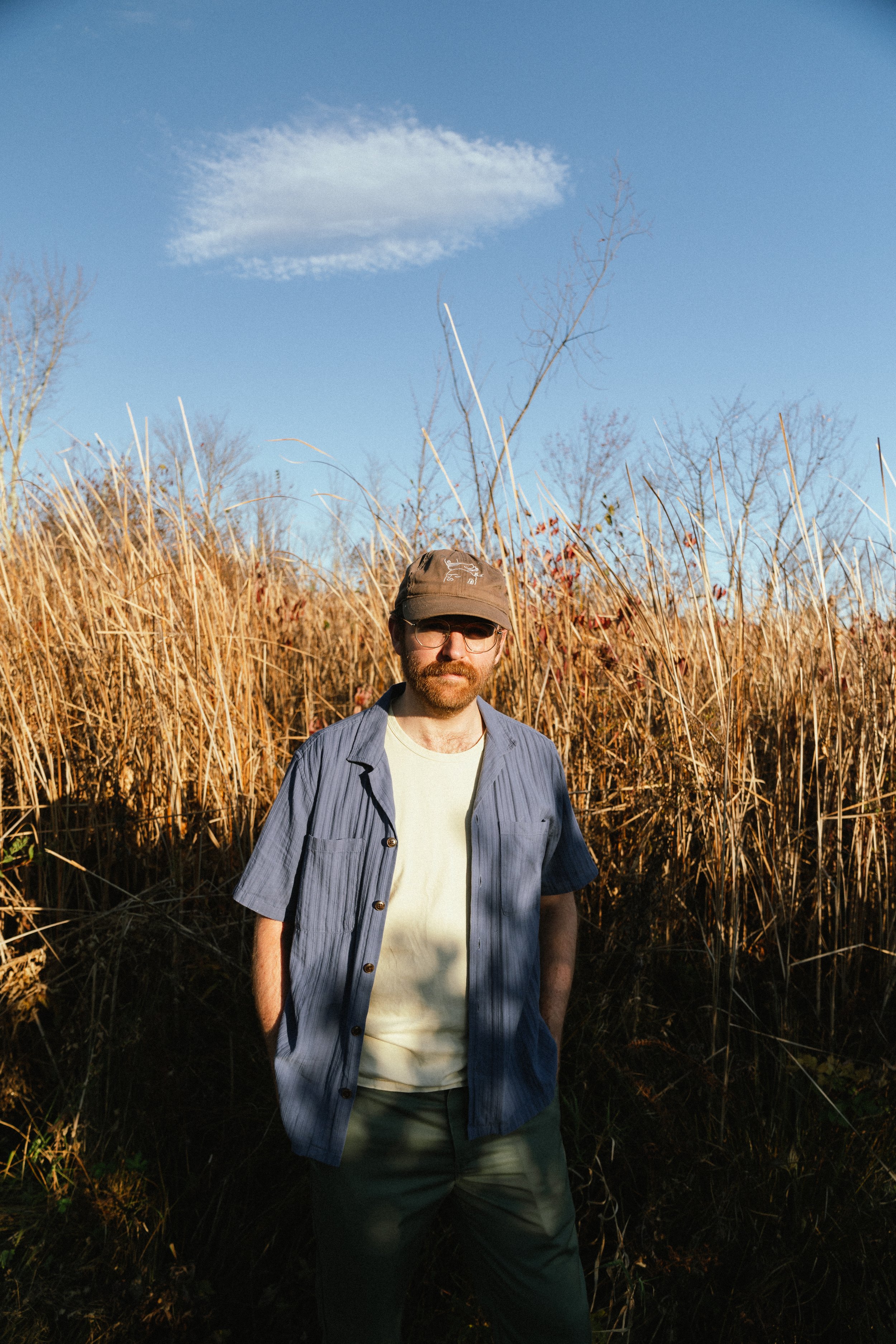
I hesitate to say that this album will have been the most difficult for me to make so far, but that might end up being true. So many times I listen to the bare tracks that we recorded a month ago, staring the thing in its face, and I don’t recognize it, or don’t care to think that it might have come from me. Many other times I listen again and it agrees with me completely, and I think that I was crazy just before to have missed what it means to me. It is a ghostly thing. I think that it will make much more sense when the weather gets colder. Somehow these albums of mine are always at their most comprehensible in fall and in early winter. It is August now, and the strings will be recorded sometime in mid-September. The basic arrangements are done and have been sent to the string players, but our cellist won’t be back in town until September, so we are going to have a couple of rehearsals and then record when she returns. In September, too, the fantastic artist Jared Ragland, who made the image above, will be coming to New York, and he and I are planning on going on a little night expedition to take some photographs for the cover art. (He will be taking the photographs–I think I will just be showing him around to good places to photograph).
The album finally has a name: Post-Empire. I think it will be obvious why it is called that when you hear it, but maybe not. It is a tensile, anxious set of songs, at least in comparison to my previous albums. There was an essay in Newsweek back in March by Bret Easton Ellis, who may be my alma mater’s most visible public figure. I go back and forth on my opinions of his work, but there is no arguing that his prose is striking. He didn’t coin the phrase “Post-Empire” by any means, but he definitely brought it deeper into the public consciousness, and gave it a nihilistic/contrarian sheen all his own. I remember reading piece after piece in places like Slate and New York Magazine and whatever, all either vehemently decrying or vehemently defending B.E.E.’s thesis. It’s not really much of a thesis, so I’m not sure that it deserved all the controversy that it stirred up. It treats Lady Gaga’s arrival at the Grammys in an egg as some sort of cultural watershed moment, which, of course, is laughable. And it treats celebrity culture in general, with Charlie Sheen as its main example, as somehow indicative of the direction of the larger culture, which is a contention that I personally disagree with, but which I can sympathize with. It is an essay about celebrity, and about which celebrities are “Empire” and which celebrities are “Post-Empire.” This is a boring idea, like tossing horseshoes onto stakes marked “rusty” and “not rusty,” so I’m going to stop summarizing it. What interests me about B.E.E.’s essay is its timing. The United States was never an empire in the old fashioned Franco-Prussian way, but that is splitting hairs. Its power is waning, and nearly everyone in America can feel it happening, bit by bit, as if the power were draining from us, too. I don’t even want to bring up the debt ceiling debate that has been lurching along in congress, lest I get caught up in some long diatribe about the shape of Eric Cantor’s head, or about the frustration of not being able to pronounce Boehner phonetically without seeming like a charlatan. The point is that this year that feeling of powerlessness has become more pronounced than in previous years. I know that I am not imagining this, or unwarrantedly chalking up individual discontent to some faceless societal ill just as a panacea–this is a real reverberation in the public consciousness. M. Ward had an album a few years ago called Post-War, and it consciously harkened back to the feel-good amnesiac love songs of the late forties and early fifties. My album is the opposite way, although it operates in a similar style. This album comes from the unshakable feeling that my country is adrift, but it largely stays away from saying anything of the sort. Instead, it is an album full of questions and doubts of a personal nature, but hopefully they project themselves upward, to a place where they no longer seem personal.